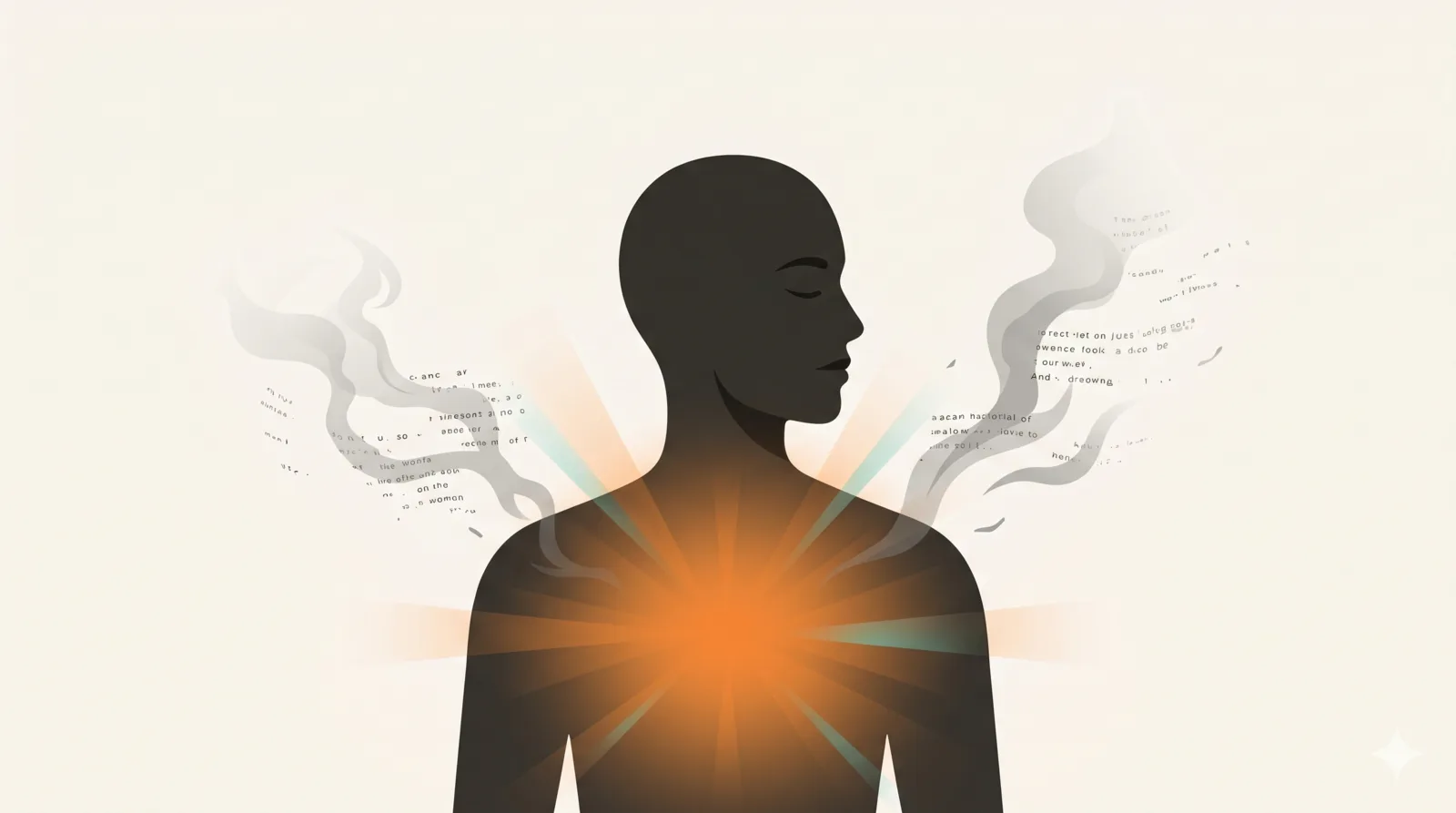
The voices in your head after narcissistic abuse are not all yours. Some belong to them. The criticism. The doubt. The quiet "you cannot do this on your own." This worksheet helps you catch those voices, name them, and replace each one with the truth that has been buried underneath.
Your voice is still in there. We are bringing it back.
Truths Reclaimed
0 / 0
How It Works
Three steps. As long as it takes.
You do not have to do this all at once. Come back as many times as you need. Every truth you write down is one less voice that gets to run your life.
1
Catch
Notice the voices that play on repeat in your head. The lies they planted. The doubts that feel like yours but never were.
2
Name
Whose voice is this, really? When did you first hear it? Naming the source breaks the spell.
3
Replace
Write the truth you know underneath the lie. The truth was always there. It just needs somewhere to live.
A note before you begin
The voices you hear feel like your own thoughts because they have been there for so long. That does not make them yours. A voice you heard a thousand times can sound like home even when home was never safe. You are about to start telling them apart.
Step 1 — Catch
Which voices have lived in your head?
Tap every voice you have heard, whether it came from them out loud or echoes in your head now. Add your own at the bottom. Be honest. No one sees this but you.
Select at least one voice to continue
Step 2 — Name & Replace
For each voice, write your truth.
Take your time. There is no right answer. The act of writing it down — even one sentence — starts the work of taking your mind back.
How to do this
For each voice you selected, three small questions. Whose voice is it really. When did it start. And then the most important one: the truth you know in the quiet moments, when their voice is not playing. Write what comes. Even a fragment. Even a half-sentence. Anything.
Step 3 — Anchor
Pick three truths to live by.
From everything you wrote, pick the three truths that matter most to you right now. These become your anchors. The lines you read when the voices get loud. Save these. Tape them somewhere you will see them.
Why three? Because in the moment when you are spiralling, you do not have time to read a page. You have time for three sentences. Make them the three that bring you back to yourself fastest.
Write your truths in Step 2 first — they will appear here for you to pick from.
When You Need It
When the voices get loud.
There will be moments — late at night, after a hard conversation, when something triggers a memory — when the voices come back at full volume. This is the protocol for those moments.
1
Pause and notice
Stop. Put a hand on your chest. Say out loud or silently: "There is a voice in my head right now. It is not all of me." The pause itself starts to break the spell.
2
Name whose voice it is
Ask: "Whose voice is this?" If it is them — name them. If it is the version of you who learned to survive them — name that. Naming creates distance. Distance creates choice.
3
Read your three anchors
Pull out your three truth anchors. Read them slowly. Out loud if you can. Twice if you need to. These are your voice. The voice that has always been there underneath.
4
Take one small action
Do one tiny thing that the truer version of you would do. Drink water. Step outside. Text someone safe. The smallest action breaks the loop. Action is what moves you out.
The voice that loves me is the one I get to keep listening to.
What's next
Take this work further.
Naming the voices is the inner work. Three more places to take it from here — your full picture, the words for the people around you, and a community that does this every day.
The deeper, ongoing work — the Trauma Bond Workshop, monthly live group sessions with Danish, 20+ AI companions for every part of recovery, and a community of survivors at every stage of leaving.
If you're already in Thrive, this is where you keep going. If you're not yet, you can join today — backed by a 7-day money-back guarantee.